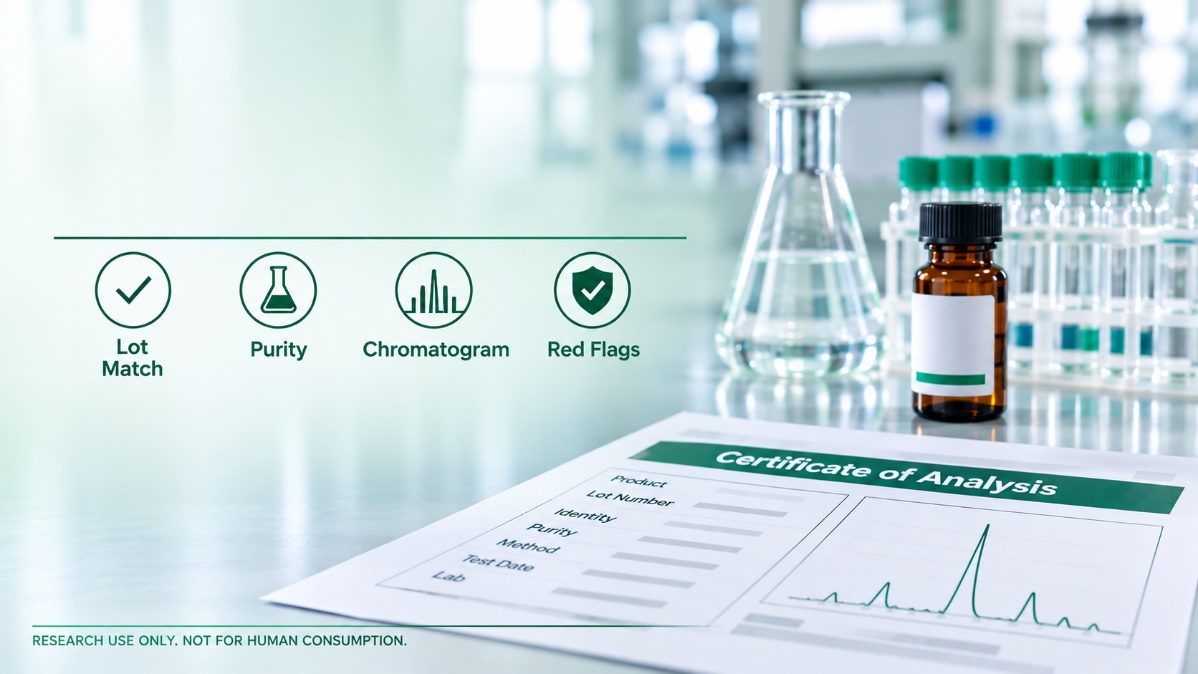
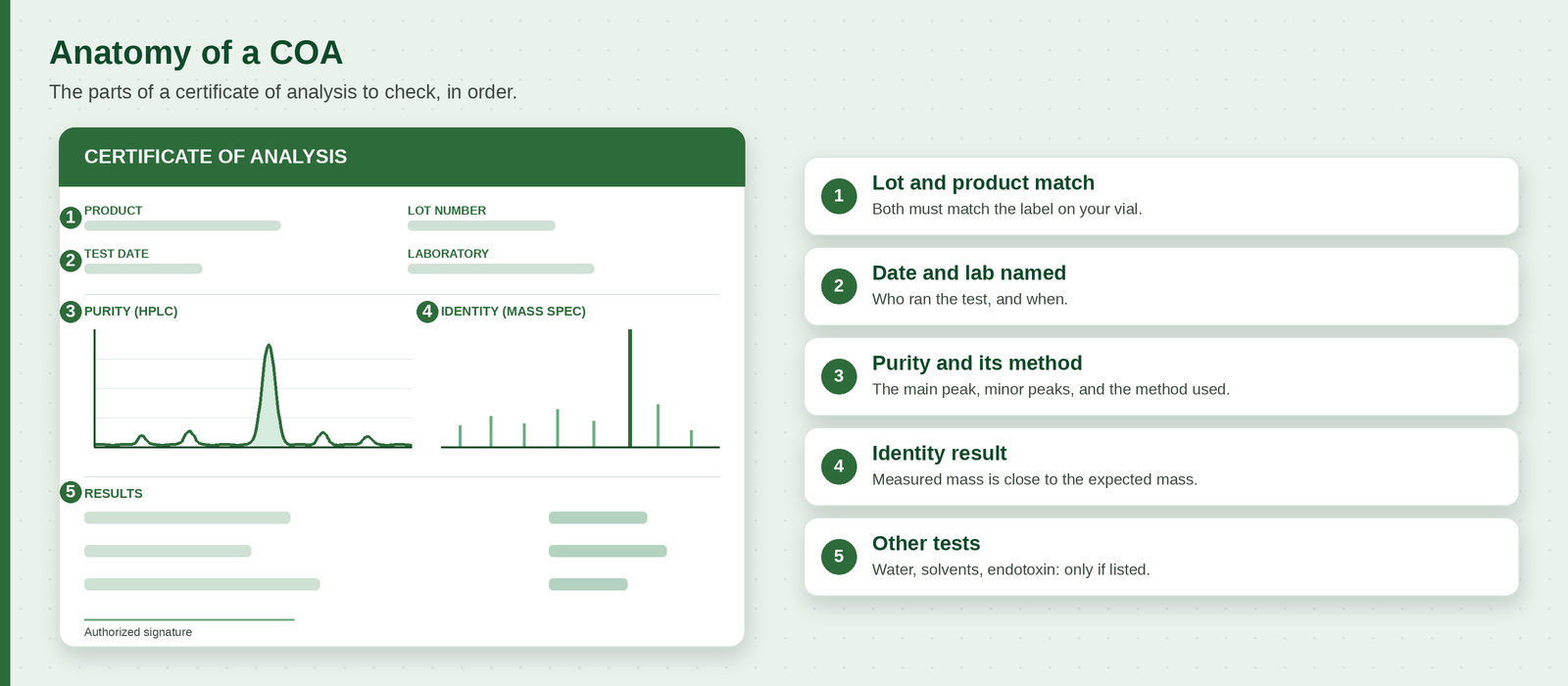
To read a certificate of analysis (COA), first confirm the lot number matches your vial. Then check the identity result, the purity result and the method behind it, the test date, and the lab name. A COA describes one lot only. If any of these items is missing, ask the seller before relying on it.
What is a certificate of analysis?
A certificate of analysis, or COA, is a report that lists test results for one specific lot of a material. It usually names the product, the lot number, the tests run, the results, and the date.
Think of it as a record, not a guarantee. It tells you what a lab reported for a sample from a lot. How much you can trust it depends on the details below.
Does the header match your vial?
Start at the top. Check that the product name and lot number on the COA match the label on your vial. A COA for a different lot tells you nothing about the one you hold.
Then look at the dates. A report date that comes long before the lot was made, or a missing date, is a reason to ask questions.
How is identity confirmed?
Identity answers one question: is this the right compound? For peptides, labs commonly use mass spectrometry (MS). The report should show an expected mass and a measured mass. The two should be close.
Some reports also compare a chromatographic retention time to a reference standard. If a COA lists a purity number but no identity test, you know how pure something is, but not what it is.
What does a purity percentage mean?
Purity is often measured by high-performance liquid chromatography (HPLC). The instrument separates a sample into peaks. The purity figure is usually the main peak’s share of the total peak area.
That number depends on the method. Look for the column type, the detection wavelength, and the run conditions. Two reports can show different numbers for the same material because the methods differ.
Also know what the number does not cover. An HPLC area percentage does not measure water, salts, or other components that the detector does not see. It describes the detected peaks, not everything in the vial.
How do you read a Chromatogram?
A chromatogram is a graph of detector signal over time. Each peak is a component. A tall main peak with small minor peaks suggests a mostly single-component sample.
Check the labels. The axes should be marked, the sample or lot should be named, and the integration should be shown. A clean-looking image without labels is hard to verify.
Look at the baseline too. A noisy or drifting baseline can affect how peaks are measured.
What other tests might appear?
Some COAs include more than identity and purity. Depending on the lab and the request, you may see appearance, water content, residual solvents, or endotoxin results.
Do not assume a test was run because it is common. If a test is not on the report, it was not reported. If you need a specific test, ask whether it was done and request the result.
Who ran the test?
Find the lab name. Was the test done by the supplier or by an independent lab? Independent testing adds a second set of eyes, but only if the report is real and tied to your lot.
Some labs hold third-party accreditation for their testing. Accreditation applies to a defined scope, so ask what it covers and how to confirm a report.
What are common COA red flags?
Watch for these signs:
- No lot number, or a lot number that does not match your vial.
- No test date, lab name, or method.
- The same chromatogram shown for several different lots.
- A purity number with no chromatogram.
- A cropped or low-resolution image that hides the baseline or axes.
- A supplier that will not answer basic questions about the report.
One red flag does not prove a problem. It is a reason to ask.
How do you compare two COAs for the same material?
Line them up side by side. Compare the methods first, then the results. If one report used a different column or wavelength, the purity numbers are not a fair match.
Compare the dates and labs as well. A newer report from an independent lab usually tells you more than an older in-house summary. Note any gaps and ask the supplier to fill them.
Do not rank reports by purity alone. A complete report with an identity result, a stated method, and a labeled chromatogram is more useful than a higher number with nothing behind it.
What if a report looks too perfect?
Real data has small imperfections. Baselines wiggle. Minor peaks appear. Every lot is slightly different.
If several lots share an identical chromatogram, or every result is the same to the decimal, ask why. There may be a simple answer, such as a template or a re-used image. Ask for the raw report or the lab’s contact details.
What should you keep on file?
Save each COA with its lot number, the date you received the material, and the storage conditions. Keep the file name clear, such as product, lot, and date.
If a report is later updated or removed from a website, your copy lets you trace earlier work. Good records also make it easier to compare lots over time.
What are common mistakes when reading a COA?
The most common mistake is reading only the purity number. A single figure is easy to remember, but it hides the method, the lot, and the date.
Another is trusting a report that was never matched to the vial. Always check the lot number first.
A third is assuming that all labs report the same way. Formats vary. Learn the parts of one report well, then use that knowledge to read others.
Quick checklist
Before you rely on a COA, confirm that it names your lot, shows an identity result, states the purity method, includes a labeled chromatogram, lists a date and a lab, and can be verified with the source. If any item is missing, ask.
Finally, remember that a COA is one input. Good records, careful handling, and your own in-house checks all support reliable work.
